In August 2025, Inverse Finance DAO voted to officially sunset DOLA-deUSD LP from FiRM’s basket of collateral markets. Earlier, in late May, the RWG had called upon its guardian role to pause any new borrows from taking place in these markets, citing Elixir’s growing operational inefficiency and evolving risk profile of deUSD.Then, just this week, Stream Finance’s collapse reportedly exposed $75M of deUSD’s backing to an insolvent counterparty.
In this latest installment of the Behind the Scenes series, we use this deUSD case study to provide an insight into how our risk curation works for Inverse Finance; the frameworks we use, the questions we ask, the trade-offs we navigate, and the messy reality of making decisions with incomplete information. This is not meant to be a victory lap, but a practical look at how risk assessment actually works in the field.
Contagion

Credit: Chaos Labs’ “DeFi’s Contagion Loop: The Cost of Hidden Dependencies”
Before diving into our specific timeline, it’s worth understanding the scope of what’s currently unfolding. Stream Finance’s $93M loss disclosed on November 3rd triggered a contagion affecting reportedly $300M-500M in interconnected lending exposure across the DeFi ecosystem. The contagion spans multiple categories of participants.
Lending markets, vault curators, stablecoin issuers, and DeFi users alike descended into immediate chaos as each scrambled to understand exposure. Morpho, Euler, Silo, Compound each saw sizable TVL declines as a fundamental design flaw surfaced: UIs treat conservative and aggressive vault curators near-identically, despite them adopting wildly different risk tolerances (mostly unbeknownst to users) while competing for deposits on the same platforms. Users selecting markets had no way short of on-chain sleuthing to assess whether curators like TelosC, MEV Capital, Hyperithm, and many more were running conservative or yield-chasing strategies. “Stablecoins” PLUSD, USDX, dnUSD, deUSD and more experienced significant depegs. And while one researchers’ latest analysis suggests cents on the dollar for xUSD, the crisis continues unfolding with many positions still open, delayed by hardcoded value oracles that could take weeks to months to trigger liquidations.
This context matters for understanding the RWG’s work as risk curators to DOLA’s backing, to FiRM, and to Inverse Finance as a whole. We can’t reliably predict collapses or contagion. But we can respond to accumulating signals about opacity, concentration risk, and operational complexity. And that’s just what we did in the case of deUSD, which on November 6th depegged permanently leaving liquidity providers with uncertainty and unrealized losses. Elixir reassures remaining holders “will be able to claim the full value” but it remains entirely unclear if they can honor this commitment given the magnitude of Stream’s insolvency.
Timeline
Winter 2024: Initial deUSD Assessment and Market Launch
Like many protocols, we evaluated Elixir’s deUSD as a potential collateral asset for FiRM markets. At the time, Elixir was pre-TGE, pre-governance, and operating with a simple structure. Our risk assessment documented the architecture: deUSD was backed by staked ETH hedged with short ETH perpetuals on centralized exchanges (via Fireblocks off-exchange storage) and MakerDAO’s USDS when funding rates turned negative. The delta-neutral strategy aimed to capture positive funding rates while the “Over-Collateralization Fund” (OCF) covered execution costs of shifting between these positions. At the time sUSDS was offering compelling yields, so deUSD was effectively a sDAI wrapper with delta hedging; straightforward exposure to T-Bills with funding rate upside. Our technical assessment identified several risk vectors (covered in the TL;DR Risk Vectors section of the above linked risk assessment), but evaluated them as manageable for an initial, cautiously-parameterized market; the structure transparent, the risks manageable for an initial deployment with conservative parameters.
Our ongoing Risk Observer Checklist kicked in immediately; weekly systematic reviews covering oracle health, liquidity conditions, collateral composition changes, and highlights of any emerging red flags. This framework was instrumental in revealing how rapidly Elixir was evolving from this simple structure into something far more complex.
Spring 2025: Red Flags Emerge
By spring, Elixir’s governance began proposing fundamental changes to deUSD’s backing structure that departed materially from what we had assessed. But prior to this, odd operational behaviour drew our concern as we began documenting. These “red flags” are shared chronologically below.
-
March 5 — Elixir launched an $ELX eligibility checker for the Season 1 airdrop. The pre-TGE points speculation had ended, but ELX suffered poor value realization due to airdrop allocation failures and confusion, FiRM included. We experienced a prolonged silence in team communication despite multiple inquiries to correct the situation, all of which went unanswered.
-
March 6 — RWG began documenting irregular operational activity following the movement of Elixir’s OCF. On March 6th, the OCF EOA holding approximately $3.2M USDT was drained to Coinbase, effectively removing a primary safety buffer and junior tranche designed to support execution costs and help stabilize redemptions during adverse market conditions.
In the days that followed, a separate EOA was funded with USDT from both Coinbase and the Elixir sUSDS multisig. The address subsequently received multiple transfers of USDT and deUSD, which Elixir described as loan repayments from the OCF to an external market-making counterparty. These funds were later used to establish a $9.5M Morpho position supported by a hardcoded price feed, alongside observed activity directed at maintaining the stdeUSD/deUSD Balancer peg. When questioned publicly, Elixir did not provide clarification or follow-up regarding the loan’s repayment status. This sequence of transactions resulted in the effective depletion of the OCF’s visible reserves, and the fund mention was later removed from Elixir’s public documentation. -
March 14 — Our Treasury Working Group approached the Elixir team inquiring about the internal ownership of a peg arbitrage bot address that utilized a KYC-whitelisted, Elixir deployer-funded wallet to mint and redeem from the deUSD/USDC Curve pool. A poor bot configuration had been using public RPC endpoints, causing Elixir’s peg management system to be heavily sandwiched on each transaction. This led to $80M in pool volume and $8,053 in losses that day; the true extent of prior capital losses was unknown. These concerns were later acknowledged by Elixir and sent internally for review.
-
April 12 — Post-TGE volatility was expected, but when combined with an extended communication blackout from the Elixir team, RWG entered a state of heightened awareness. During this period, deUSD’s TVL dropped roughly 30% from its March all-time high, and the asset backing shifted entirely to sUSDS. Morpho stdeUSD market debt surged over 100% in a single week, totaling $67M.
Mounting fixed-feed debt and declining DEX liquidity amid reduced demand increased DOLA’s dependency on whitelisted arbitrage, redemption liquidity management, and asset backing integrity. This created a growing single point of failure that tied directly to earlier concerns regarding Elixir’s arbitrage bot efficiency, operational management, and no room for collateralization deficiency -
April to May — Over the following months, Elixir governance began proposing fundamental changes to deUSD’s backing structure that materially departed from the model originally assessed by the RWG. These developments can be summarized across two significant proposals that preceded the pause decision.
Proposal 1: Establish a Gauntlet-Curated sUSDS Treasury Vault
Elixir governance introduced the Gauntlet-Curated sUSDS Treasury Vault proposal, which passed through governance virtually uncontested. The proposal allocated up to 120M sUSDS, approximately 66% of deUSD’s total backing, into a managed vault designed to generate additional yield. This materially increased contract and liquidity risk, as these funds represented core redemption reserves relied upon by DEX arbitrageurs and whitelisted market makers.
The RWG publicly raised concerns in the governance thread, questioning redemption liquidity, available buffers, and adaptive utilization thresholds. Gauntlet responded with two theoretical mitigation options, but Elixir advanced the proposal to an on-chain vote without engaging further or confirming a preferred safeguard. If executed as written, these allocations to hardcoded-feed markets would be non-withdrawable until debt repayment, effectively removing them from redemption access and further undermining peg stability amid weakening liquidity conditions.
Proposal 2: Deployment of Elixir Treasury sUSDS into a MEV Capital–Managed Morpho Vault
This proposal sought to deploy up to $120M of Elixir’s ~$150M sUSDS treasury (roughly 80% of holdings) into a MEV Capital–curated Morpho vault, representing a complete restructuring of deUSD’s collateral architecture. Under this framework, deUSD’s backing would be lent out through Morpho and managed by an external curator, introducing multiple new layers of counterparty, contract, and liquidity risk absent from prior assessments.
The proposal further expanded acceptable collateral to include Stream Finance’s xUSD, with MEV Capital noting their intent to “progressively propose the addition of neutral, non-yield-bearing stablecoins such as xUSD as eligible collateral.” This marked a significant departure from deUSD’s originally assessed composition and risk model.
The RWG Decision to Pause the deUSD Market (May 30, 2025)
By late May 2025, RWG concluded that deUSD’s collateral structure and liquidity profile had diverged substantially from the parameters originally underwritten by FiRM, resulting in compounding single points of failure and unsustainable governance behavior. While no immediate threat was observed, the integrity of deUSD’s risk framework had materially deteriorated.
Each preceding red flag had incrementally heightened RWG’s situational awareness and focus. The group’s internal monitoring tools designed to detect early deviations in liquidity health, collateral distribution, and operational transparency had consistently identified these stress signals as they emerged. Together, these tools and the structured Observer Checklist process enabled RWG to track a clear pattern of degradation, culminating in a well-supported decision to act before risk materialized on-chain.

Throughout the spring, several developments highlighted this growing fragility:
-
DEX liquidity contracted sharply, leaving the Curve DOLA-deUSD pool as the primary permissionless on-chain liquidity source and creating dependency on a narrow trading corridor for peg maintenance.
-
Morpho lending exposure on stdeUSD markets expanded, with mounting fixed-feed debt positions immobilizing collateral and reducing its ability to absorb volatility.
-
The OCF, once a key redemption,execution buffer and junior tranche, had been drained and rebranded, removing a critical safeguard for orderly redemptions.
-
Communication between Elixir and DAO stakeholders deteriorated throughout this period, with repeated inquiries on operational matters and governance decisions left unanswered, contributing to growing uncertainty around internal decision-making and collateral transparency.
-
Two consecutive governance proposals (Gauntlet and MEV Capital) each sought up to 120M sUSDS, a combined 240M in allocations exceeding deUSD’s entire collateral backing at the time and redirecting the majority of reserves into externally managed lending vaults, introducing third-party and counterparty risk while disregarding liquidity requirements needed to sustain redemptions.
For RWG, this represented a loss of confidence in Elixir’s governance discipline. The simultaneous pursuit of allocations surpassing total collateral value demonstrated a widening disconnect between yield objectives and responsible risk management. As deUSD liquidity thinned and collateral became increasingly locked within fixed-feed markets, DOLA’s stability on FiRM grew dependent on a single DEX pairing and a small set of whitelisted arbitrage bots; one of which had already shown operational inefficiencies and losses.
At this stage, RWG determined that continued exposure presented unacceptable systemic dependencies. Exercising its Pause Guardian authority, RWG temporarily halted new borrowing activity in the deUSD markets. This action was preventative, not reactive, intended to preserve FiRM’s solvency perimeter and provide the DAO time to reassess deUSD’s evolving risk composition.
The pause demonstrated that Inverse Finance’s risk management operates independently, transparently, and with discipline, guided by empirical monitoring rather than sentiment. RWG’s decision reflected professional prudence: when governance drift and structural dependency begin to compromise the assumptions behind an asset’s safety, the appropriate time to act is before confidence fails, not after.
In June, the Sei Network proposal confirmed many of the concerns that had driven the earlier decision to act. Elixir proposed an initial $5M migration of deUSD collateral to Sei to back fastUSD, describing it as “the first step in a broader strategy to diversify deUSD collateral across multiple ecosystems.” This language explicitly signaled future allocations beyond Sei, indicating the beginning of a systematic redistribution of deUSD’s redemption backing off Ethereum mainnet.
The initiative marked yet another significant shift away from the stable, transparent architecture RWG had initially underwritten. By extending collateral across new ecosystems, Elixir introduced additional bridge, custody, and synchronization risks. This strategy directly conflicted with RWG’s previously stated emphasis on maintaining reliable, accessible on-chain redemption liquidity as the foundation of deUSD’s peg stability. Fragmenting collateral across multiple networks weakened those redemption pathways, complicating liquidity management and reducing the predictability of capital availability under stress.From RWG’s perspective, this development validated the analytical framework and early warnings that led to the pause.
The red flags identified throughout the spring - shrinking DEX liquidity, mounting fixed-feed debt, the removal of the OCF, and excessive external allocations, had all pointed toward a structural drift in Elixir’s governance priorities. The Sei proposal confirmed that this drift was ongoing rather than isolated, reinforcing the importance of decisive, preemptive action.
Collectively, these governance actions crystallized the problem: RWG could no longer rely on the initial assessment of deUSD. The protocol had transitioned to a complex, externally managed, multi-chain system that multiplied potential failure points through vault curators, cross-protocol dependencies, and novel collateral types. Each successive governance action required a full reassessment of deUSD’s risk profile from first principles, confirming that RWG’s early intervention had been the correct course.
Summer 2025: Decision to Remove Exposure
By August 2025, RWG presented its findings to the DAO, outlining the accumulated evidence gathered during the observation period and recommending a full withdrawal of deUSD exposure from FiRM. This decision formally proposed sunsetting the deUSD LP markets, concluding that the asset no longer aligned with FiRM’s collateral standards or operational risk tolerances.
At this point, RWG’s assessment reflected a clear and validated pattern: Elixir’s governance trajectory had continued to introduce unmitigated external dependencies, fragment redemption liquidity, and dilute collateral transparency. The risk conditions that first prompted the market pause had not improved; instead, they had evolved into structural features of the deUSD ecosystem. The removal of exposure was therefore not a retreat from innovation but a reaffirmation of our risk discipline and its responsibility to safeguard DOLA stability.
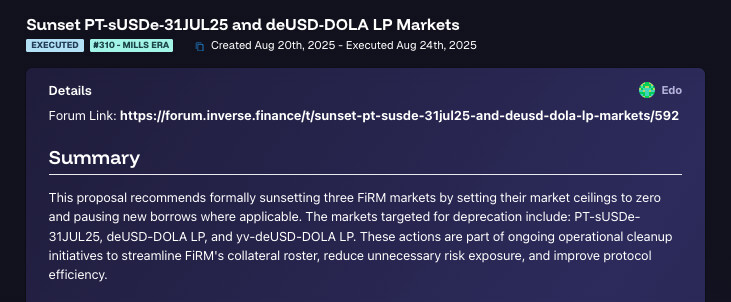
Interestingly, at the same time that RWG moved to deprecate deUSD exposure, Gauntlet was recommending the addition of deUSD and stdeUSD as collateral across Compound Finance’s Mainnet stablecoin Comets. The divergence was instructive: two curators analyzing the same asset reached opposite conclusions, each consistent with their own framework, priorities, and tolerance for risk.
Our Internal Risk Frameworks
Several frameworks and cultural practices within the RWG enabled us to identify and act on the deUSD risk as it evolved. Rather than abstract principles, what follows is our actual thought process and actions, the frameworks in practice.
Operational Overhead as a Risk Signal
A crucial insight: the difficulty of monitoring an asset is itself risk information.
By late May, the operational burden of tracking deUSD had grown substantially. We could have staffed up to handle the monitoring overhead. Instead, we recognized it as a symptom: the protocol was moving away from immutable, battle-tested infrastructure toward complex, interconnected systems that multiply potential failure points. Each new proposal required re-evaluating our entire risk position. This logic later evolved into a new framework for the RWG; the “Collateral Screening Framework”. In short, a standardized process for evaluating the “Lindy Effect” of prospective collaterals before they can be considered for onboarding to FiRM.
Trust but Verify
Throughout this process, we maintained direct communication with the Elixir team. The quality and reliability of that communication proved insufficient.
Our initial round of questions in February following the risk assessment received responses that were satisfactory: permissionless minting timeline, off-chain collateral verification protocols, multisig structure, plans for timelocks and governance transitions. These answers addressed our immediate concerns about operational security. The problem: several key commitments were never honored. Elixir stated they were “exploring implementing” timelocks for deUSD/sdeUSD contracts but none were ever set up to our knowledge. They claimed that “post public mainnet issuers will have to pass a comprehensive risk framework as well as a governance vote before Elixir natively integrates into the fund issuer” yet governance proposals like MEV Capital’s vault and the Sei deployment passed with minimal scrutiny or risk frameworks. When we asked on June 20th about plans for supply caps per strategy and risk isolation, they responded “yes to both, we’ll be introducing supply caps and taking a siloed approach.” This was never implemented. As the protocol evolved, so did our questions, and responses became increasingly evasive.
The lesson here isn’t just “ask questions”. It’s trust but verify. In hindsight, we shouldn’t have moved forward based on stated intentions without verification of implementation. Promises of future improvements aren’t risk mitigations; implemented, verifiable controls are.
Precautionary Measures Escalating to Significant Action
Our response evolved with the accumulating evidence:
-
March-April: Enhanced Monitoring - Increased frequency of collateral composition checks, began tracking Morpho market dynamics, started documenting governance proposals affecting backing structure.
-
May 30: Market Pause - Exercised guardian role to pause new borrowing, entering formal 6-week observation period. Not a sunset, but a clear signal that the risk profile had shifted enough to warrant defensive positioning.
-
July 9: Permanent Deprecation Recommendation - After the observation period, we concluded the fundamental risk-reward calculus remained unfavorable. Elixir remained in what we’d characterize as an “adolescent phase of development, creating substantial ongoing monitoring burdens that are disproportionate to the market opportunity."
This rollout; precautionary pause, structured observation period, data-driven permanent decision, prevented us from either overreacting to early signals or underreacting to accumulating evidence.
Cultural Willingness to Say NO
Perhaps most importantly: we’ve cultivated a culture where the RWG’s job is to say no when the evidence warrants it, even when that creates friction. Many of our recommendations faced pushback. There was a genuine opportunity cost; the market could have generated meaningful debt. But we stood by the analysis. Risk management isn’t about being right every time. It’s about having processes robust enough that you’re right often enough, and when you’re wrong, you’re wrong in ways that don’t destroy the protocol.
A Call for Better Oversight and Transparency
This latest DeFi crisis should prompt serious introspection from everyone involved in or affected by risk curation:
For Curators: Your job is to say NO. If you’re not regularly rejecting high-yield opportunities because the risk doesn’t justify the return, you’re not managing risk - you’re marketing yield with extra steps.
For Lending Platforms: Curated market models enable innovation but require oversight. Consider implementing maximum exposure limits per curator. Require standardized transparency disclosures from all curators. Build circuit breakers that pause markets when aggregate exposure to single assets exceeds safe thresholds. Regularly stress test curator positions against historical volatility.
For Protocols Building Yield Products: If your strategy relies on opacity, recursive leverage, or off-chain pricing that users can’t independently verify, you’re not building the future of finance, you’re rebuilding the shadow banking system that caused the 2008 financial crisis. The whole point of DeFi was transparency and verification. If your protocol can’t operate with full transparency, reconsider the business model.
For Users: “If you don’t know where the yield comes from, you are the yield.” This maxim proved true again. Demand clear, verifiable explanations of return sources. Avoid products where collateral composition requires detective work to trace. Favor protocols with track records of conservative risk management over newest/highest yields. Recognize that yield above organic market rates must come from somewhere.
For the Industry: We need to collectively develop and adopt risk standards. Not regulation imposed from outside, but professional standards developed by practitioners who understand the trade-offs. They won’t prevent all failures. But they’ll make it easier for good actors to differentiate themselves from bad.
Catch you next time.
For more on our risk management practices, visit our dedicated website the Risk Working Group Digest.